.jpg)
Organisations’ Sustainable Cost Management Strategies to Enhance Biodiversity
At a recent Wrexham Business School research seminar, Eranda Abeysinghe, PhD researcher and Lecturer in Accountancy and Finance, presented his ongoing doctoral work on how organisations can use sustainable cost management strategies to support biodiversity outcomes. As a third-year PhD student, Eranda’s research is situated at the intersection of sustainability, management accounting, and organisational strategy, addressing an important gap in the current literature.
Eranda opened by highlighting the increasing recognition of biodiversity as a critical component of sustainable ecological systems, alongside ongoing concerns that management accounting research has largely overlooked how organisations cost and manage activities that support biodiversity. While many companies now make public pledges on environmental responsibility, commitments often remain passive and lack the structured cost management frameworks needed to drive tangible outcomes.
A case study focus is Sri Lanka’s human–elephant conflict, a long-standing environmental and social challenge. Sri Lanka is home to an estimated 2,500–3,000 wild Asian elephants, a dramatic decline from historical estimates of around 30,000 in the early 20th century, largely due to habitat loss and fragmentation. Elephants in Sri Lanka, which hold significant cultural and religious value in the predominantly Buddhist society, can travel up to 30 kilometres a day in search of food. This often brings them into agricultural areas at night, leading to crop damage and occasional human–wildlife conflict.
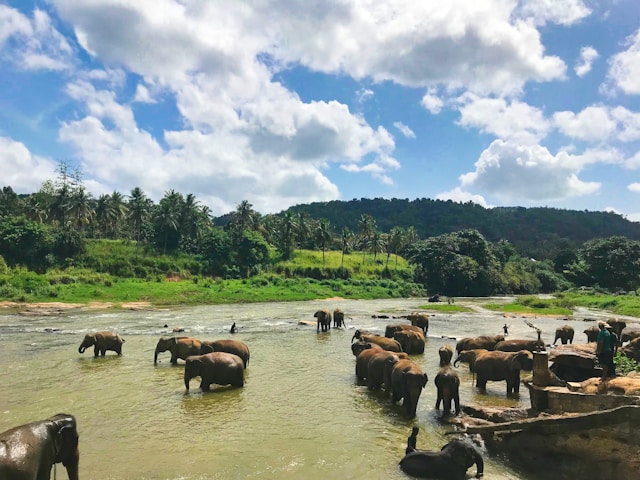
Governments, civil society, and private sector actors in Sri Lanka have invested in various mitigation strategies, such as electric fencing, wildlife corridors, alternative crop planting (for example, species that elephants tend to avoid) and community compensation schemes. However, Eranda noted that there is limited research on how organisations internally manage and cost these biodiversity-related interventions, especially from a management accounting perspective.
His research is guided by two core questions:
- How can cost management strategies be designed to support biodiversity enhancement?
- What approaches can organisations adopt to develop sustainable cost management strategies that are ecologically effective?
To address these questions, Eranda uses institutional isomorphism as a theoretical lens, considering how organisational practices become aligned with environmental expectations over time. He proposes a framework that integrates the “3Ps” of sustainability — People, Planet, and Projects — with cost management at its heart, emphasising both ecological and organisational value.
Methodologically, the research adopts a mixed-methods approach. This includes:
- Secondary data analysis of publicly available expert reports and organisational disclosures
- Trend and regression analyses to identify patterns in cost and biodiversity outcomes
- Primary qualitative data through interviews with government officials, organisational leaders, NGOs, and communities affected by biodiversity challenges analysed using thematic analysis
- Questionnaire surveys and structural equation modelling (SEM) to explore relationships between cost strategies and biodiversity outcomes.
Ultimately, the research aims to develop a biodiversity-centred cost management model that can be applied beyond the case of elephants to other species and ecological contexts, such as tigers, rhinos or pollinators like butterflies.
The seminar demonstrated how sustainability research in management accounting can move beyond financial reporting to explore how organisations strategically manage costs to support ecological integrity, offering pathways for future research and practice in sustainable organisational decision-making.