BEng (Hons) Electrical Engineering
Course details
UCAS Code
H600
Year of entry
Sept 2027
Duration
3 YRS (FT)
UCAS Tariff
96-112
Institution Code
G53
Location
Wrexham
Why choose this course?
The BEng (Hons) Electrical Engineering prepares you for careers in energy, automation, and advanced technology sectors. Combining theory with extensive lab work, the programme uses an exam-free, industry-focused approach to build practical skills and professional readiness for a wide range of engineering roles.
You will:
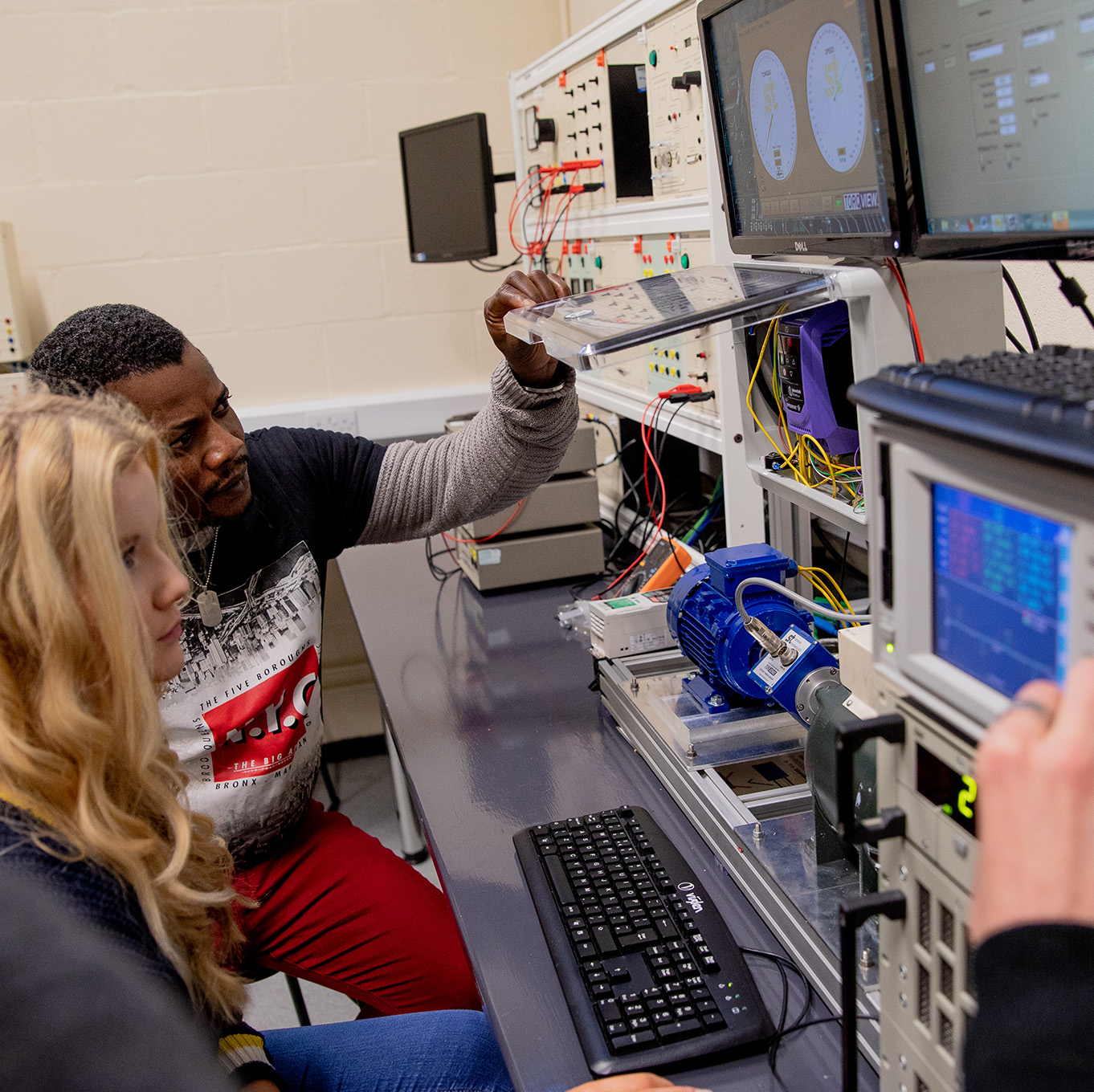
- Gain extensive hands-on experience in modern laboratories equipped with industry-standard tools and technologies
- Experience innovative, exam-free assessment through coursework, lab tasks, and project-based work
- Benefit from strong employer links, with industry input shaping course content and opportunities
- Apply your knowledge through collaborative Engineering Design Projects that solve real-world challenges
- Learn through a blended approach that combines on-campus teaching with digital learning support
- Graduate ready for roles in electrical engineering, automation, energy, telecommunications, or further study
Did you know?
By studying an BEng (Hons) Electrical Engineering degree at Wrexham University, you'll gain access to unique benefits designed to help you succeed…
Key course features
- This course is designed in line with the AHEP-4 framework, ensuring professional and industry relevance
- In this course, you will explore specialist modules such as Industrial Automation & PLCs, Power Distribution & System Design, and Digital Communication Techniques
- The course will allow you to develop practical expertise in control systems, electrical machines, and industrial communication protocols
- In your final year, you will undertake an individual project to showcase your technical and professional skills to employers
- Enhance your final year with a professional placement, embedded within the Professional Practice module. Lasting up to 12 weeks in Semester 2, this valuable opportunity allows you to gain real-world industry experience, strengthen your CV, and build professional networks before graduation
- Please note that this degree is currently subject to validation. Course content, structure, and module titles may be subject to change prior to final approval
What you will study
Year 1 (Level 4)
In year one, you will be introduced to the core concepts of electrical and electronic engineering. Practical understanding is further developed through hands-on modules including engineering design and CAD and practical engineering skills, delivered in modern laboratory environments.
Modules
- Engineering maths: To provide a foundation of mathematical knowledge and develop the application of mathematical principles in the solution of engineering problems, including use of computer modelling software.
- Core engineering skills and application: This module combines conceptual teaching with guided practical work to strengthen your understanding of fundamental principles. You will explore how theoretical knowledge connects with real-world practice through structured experimentation and applied tasks. It provides the core skills and knowledge for a foundation in engineering.
- Fundamentals of electrical engineering: You will learn the foundational principles of electrical and electronic engineering, developing an understanding of components and circuit theories that will support progression to more advanced study .
- Engineering design and CAD: You will apply engineering design principles using industry-standard CAD tools and engineering design methodologies, which will help create precise 2D drawings and 3D models while integrating theoretical knowledge with practical design applications.
- Engineering materials and processes: This module introduces students to the fundamental principles of engineering materials and manufacturing processes by using different types of materials, their properties and manufacturing processes
- Practical engineering skills: Through practical exploration, you will learn about core concepts and gain practical engineering skills through hands-on workshop and laboratory activities.
Year 2 (Level 5)
In year two, you will expand your knowledge and participate in the engineering design project, working collaboratively on real-world challenges that promote innovation, teamwork, and systems thinking.
Modules:
- Power, distribution and system design: You will gain an understanding of the operation of power electronic systems/devices and electrical machinery including the appropriate analytical techniques to undertake the design and evaluation of power electronics and electrical machines applications.
- Industrial communication protocols: This module will equip you with the knowledge and skills required to analyse, apply, and evaluate industrial communication systems, with particular emphasis on reliability, robustness, and security in safety-critical industrial environments.
- Industrial automation and PLCs: You will gain the knowledge and practical skills required to design, implement, and evaluate industrial automation systems using programmable logic controllers (PLCs) and associated technologies, preparing them for application in real-world engineering environments.
- Control system diagnostics: This module develops your understanding of the principles and methodologies underpinning control system design and diagnostics. It covers both time domain and frequency-domain analysis, classical proportional–integral–derivative (PID) control, and advanced control strategies, including model predictive control with Kalman filtering and reinforcement-learning-based autonomous systems
- Engineering design project: You will learn how to design, develop, and implement a solution to a partially defined engineering problem. Working collaboratively, you will apply analytical, practical, and engineering skills to develop an effective solution and present your outcomes
Year 3 (Level 6)
In year three, the focus shifts to advanced and specialist topics. The professional practice module prepares you for professional roles within the sector, while the final individual project allows you to demonstrate your technical and analytical abilities through independent investigation into a topic aligned with your career aspirations.
Modules:
- Electrical modelling and simulation: To develop an understanding of the analytical skills and knowledge required in the engineering design process and how it can be improved through the use of engineering modelling and simulations. You will develop industry-standard software techniques to model and solve specific engineering problems. Typical software examples might be ANSYS for mechanically related programmes.
- Digital communication techniques: You will have an advanced understanding of digital communication systems, to equip you with the analytical, design, and simulation skills required to evaluate, design, and implement effective solutions to real-world engineering challenges.
- Power and electrical machines: To learn about power electronic systems/devices and electrical machinery including the appropriate analytical techniques to undertake the design and evaluation of power electronics and electrical machine applications.
- Professional practice: This module is delivered through a complex engineering project that fosters creativity, innovation, and the development of business awareness. You will learn to understand their impact and position within industry and society
- Project: You will design and execute experiments or technical tasks that test and refine complex theories. This module will teach you to apply and extend the knowledge acquired in taught modules through the completion of a professional engineering project. In doing so, it develops practical engineering skills, research capability, and industry-relevant experience, preparing students for progression into professional practice.
NOTE: Please note that this programme is currently subject to validation. Course content, structure, and module titles may be subject to change prior to final approval.
The information listed in this section is an overview of the academic content of the programme that will take the form of either core or option modules. Modules are designated as core or option in accordance with professional body requirements and internal academic framework review, so may be subject to change.
Entry requirements & applying
The academic requirements for the course are 96-112 UCAS tariff points at GCE A-level or equivalent, including Maths or Physics.
Teaching & Assessment
Our teaching approach is designed to be flexible, engaging, and focused on your success. Learning is delivered through Wrexham University’s Active Learning Framework, blending on-campus sessions with online activities to give you the best of both worlds. You’ll develop key employability skills throughout your studies, with teaching that adapts to your needs and prepares you for the demands of your future career.
- Face-to-Face Learning: You will engage in lectures, seminars, and workshops in various settings, incorporating case studies and problem-based learning. In some instances, sessions maybe be recorded for later access via the Virtual Learning Environment (VLE)
- Virtual Learning: Delivered through the VLE and Microsoft Teams, virtual learning includes asynchronous tasks (videos, quizzes, readings, virtual visits) and synchronous activities (discussions, case studies, simulations). Sessions will be recorded where appropriate
- Tutorials: Delivered both in person and online, tutorials promote active participation through individual and group engagement. They are designed to encourage critical thinking, reflective practice, and student-led learning, supporting creativity, independence, and a deeper understanding of subject knowledge and professional practice
- Assessment Strategy: The degree has an innovative assessment strategy with no formal exams, replacing them with coursework, practical work, and project-based assessments that mirror industry practice. This approach, combined with access to modern facilities and strong employer input, ensures graduates are well-prepared for employment or further study in the sector
Teaching and Learning
We offer workshops and support sessions in areas such as academic writing, effective note-making and preparing for assignments.
Students can book appointments with academic skills tutors dedicated to helping deal with the practicalities of university work. Our student support section has more information on the help available.
In terms of particular needs, the University’s Inclusion Services can provide appropriate guidance and support should any students require reasonable adjustments to be made because of a recognised prevailing disability, medical condition, or specific learning difference.
Career prospects
Our dedicated Careers and Employability team is committed to helping you achieve your professional goals. They provide personalised advice, useful resources, and extracurricular employability events to prepare you for the job market.
Graduates of this course can pursue careers in:
- Electrical Design Engineer
- Control and Automation Engineer
- Power Systems Engineer
- PLC and Industrial Automation Specialist
- Telecommunications Engineer
- Electronics Development Engineer
- Renewable Energy Engineer
- Electrical Maintenance and Reliability Engineer
- Systems Integration Engineer
- Research and Development Engineer
Additionally, you may choose to further your expertise through postgraduate studies. Explore our postgraduate courses for more information.
Fees & funding
You do not have to pay your tuition fees upfront.
The fees you pay and the support available will depend on a number of different factors. Full information can be found on our fees & finance pages. You will also find information about what your fees include in the fee FAQs.
All fees are subject to any changes in government policy, view our undergraduate fees.
For international students looking to study this course please see our international fees.
Accommodation
At Wrexham University, we offer on-campus en-suite rooms within our Wrexham Student Village. These private, fully furnished spaces are conveniently located, providing easy access to campus facilities, study areas, and social spaces. Plus, you’re just a 10-minute walk from the city centre!
With all bills included, free Wi-Fi, 24/7 security, and large social areas, you’ll find everything you need for a great student experience.
Explore our student accommodation options to find your perfect home away from home.
International
This course is open to international students, for information about the university’s entry requirements for EU/international students, please visit our international section.
Ready to apply?
Apply Link Accordions
Content Accordions
Don't Miss Out on Visiting Us.
Whether you have applied through Clearing or you're considering applying, you can still join us at our next Open Day. Meet our academics, chat with current students and explore our campus. This is your chance to picture your future here.
