Peace Through Language Workshop 2026
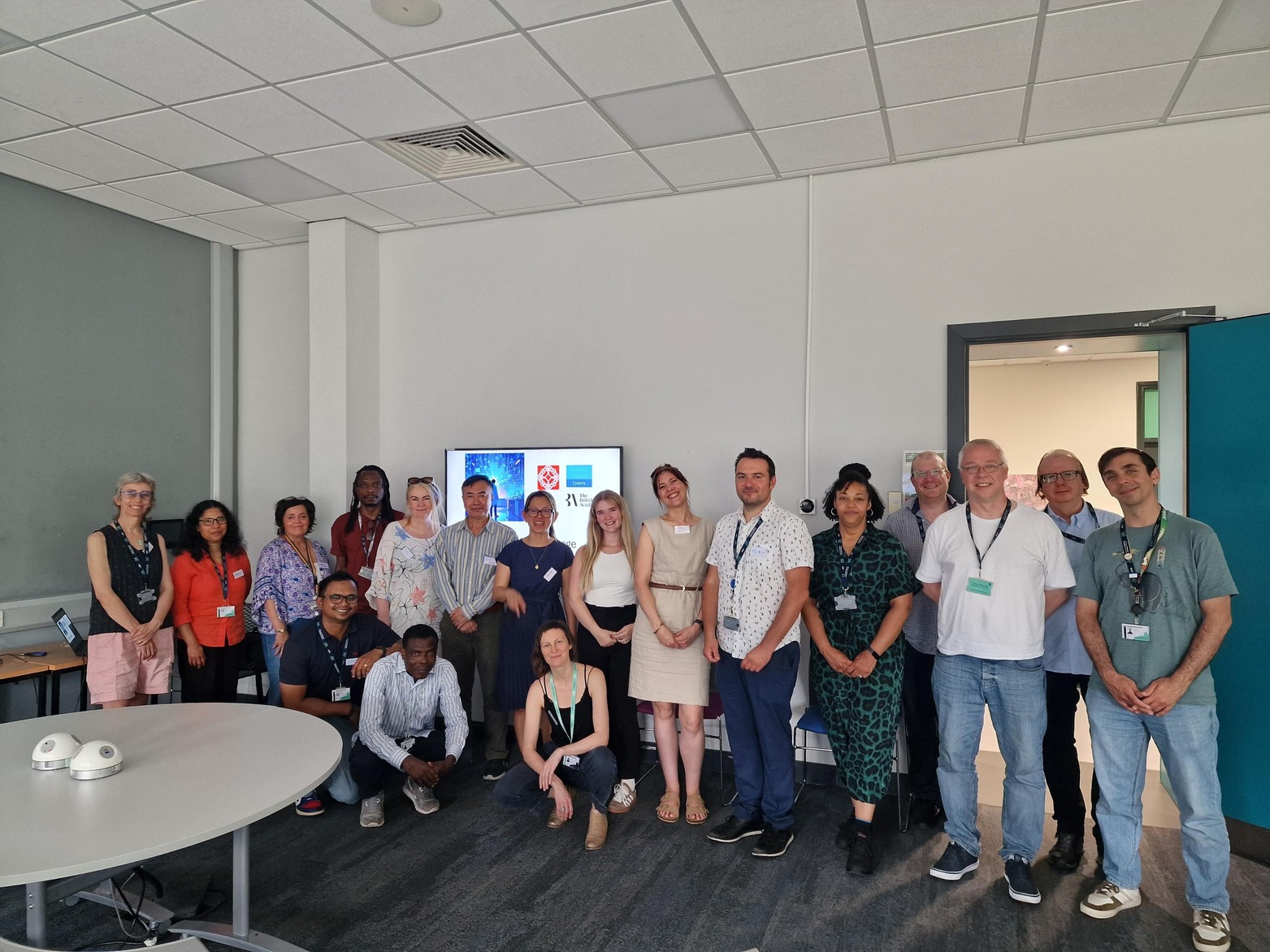
At the end of 2025, Dr Phoebe Teh, Reader in Social Computing, was notified that her Research Workshop Grant application, via The Learned Society of Wales, had been successful.
Research Project
The research project titled Peace through language: measuring online hate’s impact is designed to explore how online hate speech affects people both emotionally and physically, by analysing toxic language and measuring stress responses. Part of the aim is to create a multilingual hate speech database and educational resources.
So, Phoebe and her collaborator, Professor Cheng Chi-Bin from Tamkang University, Taiwan, set about planning a workshop to support peace and respectful communication. The workshop was hosted in person at Wrexham University at the end of June 2026, with a diverse cross-section of attendees including school educators, lecturers, Public Health Wales, Academi Heddwch Cymru (the Welsh Peace Institute), and Prof. Cheng Chi-Bin who travelled from Taiwan.
Welcome Address
Jayne Rowe, Research Impact Manager at Wrexham University, opened the workshop with welcomes and an introduction to the day. The broad context of the research project was introduced alongside the concept that whilst online communities can provide valuable support networks, they can also cultivate cultures of hostility that undermine constructive dialogue and Phoebe’s research aims to help address this.
.jpg)
Building Peaceful Communities
It was then over to Professor Colin Mclnnes, Research Lead for Academi Heddwch Cymru (Wales' national peace institute) and a social scientist who brings a wealth of experience to his role. Colin has previously held a range of public sector and charitable body roles, including the first UNESCO Chair in Wales, and he worked at the World Health Organisation to develop a framework to improve civil-military relations in health emergencies.
Colin shared that when preparing for the session he reflected on what actually makes a peaceful community, wondering whether the ‘age of community’ still exists, or whether it has passed. Governments don’t invest in physical community spaces in the same way that they used to, which limits opportunities for communities to come together in person.
Whilst online spaces can offer an alternative, it can, in some instances, provide space for online hate and toxicity which can have detrimental impacts on people. When socialising in the physical community, if someone uses hateful language or shares harmful views, they may well be ‘confronted’, ‘called out’ or ‘challenged’ on these views by way of holding them to account and protecting the greater collective.
However, the lack of face-to-face accountability may empower some online users to spread hate and vitriol. There have been recent community-based examples in the UK and Ireland of how online rhetoric can sometimes lead to civil disturbances, and there appears to be shifting zeitgeist away from community and government rule and more towards ‘might over right’, meaning ‘if you want to’ then ‘you can’.
-(1).jpg)
In the context of creating peaceful communities, it is important to understand what is meant by peace:
· Negative peace is the absence of war and violent conflict
· Positive peace fosters social and economic fairness which actively supports peaceful communities
Colin suggested that the old sense of community is ‘dying’ and the new is ‘yet to be born’, we are in the midst of change, and we are unsure what the world will look like moving forward. Attendees wondered whether globalisation is working at a macro level but failing at a micro level, creating a sense of an ongoing threat.
The concept of social cohesion was put forward: accepting differences, living well together, and understanding the common good, and ways in which this could be measured were considered. The drivers behind the current breakdown in social cohesion are vast and complex, and the fact that there is no agreed measure of social cohesion further adds to the issue. Did you know that the UK is ranked 39th in the Global Peace Index Report 2026?
Colin highlighted that whilst Welsh Government has had conversations with social media companies about managing algorithms more effectively to reduce online hate and support peaceful communities, the UK actually accounts for < 5% of global social media traffic, and Wales’ percentage is even smaller, which affects the sphere of influence we hold. So, how can we build peaceful communities? Colin emphasised the power of education, it’s a single point of intervention where we have an opportunity to educate, inform and influence, as most young people engage in mainstream education. Long term focus, investment, and collaboration are important, alongside increasing capacity for physical community connections. There isn’t a clearly defined central checklist that we can work towards, but leading with informed research, kindness, and education will surely set us on the right path.
How AI Can Detect Hate Speech
Professor Cheng Chi-Bin then shared detail on the approaches that may be taken by the research team in detecting online hate speech. Prof. Cheng and Dr Teh have been collaborating for over eight years and have co-authored at least five publications in areas including hate speech detection, cyberbullying, sentiment analysis, and social computing.
Several of the studies, datasets, methodologies, and case studies presented in this workshop are derived from their joint research, providing participants with insights from their long-standing international research collaboration.
-(1).jpg)
Prof. Cheng started his session with the distinction between cyberbullying and hate speech:
· Cyberbullying typically targets a specific individual(s) to cause personal distress
· Hate speech is communication (in various forms) that disparages, demeans, or incites hatred against an individual or a group
The limitations of manual moderation of hate speech in the social media spheres were then highlighted:
· In excess of 69 million private messages and 360,000 public messages are shared every MINUTE globally
· The data is unstructured, often conversational, fast paced, and may use ‘slang’ terms
There are various AI based approaches that can help in detection / moderation, including Lexical Approaches that use pre-defined lists of words to analyse and categorize text. Whilst this has a number of advantages, there are also limitations including people altering the spelling of words to bypass the system:
Hate = H@te / H*te / H.a.t.e
Prof. Cheng provided an overview of Large Language Models (LLMs) and the different types of machine learning including supervised and unsupervised machine learning, semi-supervised, and reinforcement learning. These were then considered in the context of detecting hate language and how the sequential nature of language plays a part in the models used.
· Long Short-Term Memory (LSTM) – addresses the issue of ‘AI amnesia’ where the beginning of a long sentence can be forgotten by the machine
· Bidirectional LSTM (BLSTM) – reads a sentence from both directions simultaneously to ascertain meaning quicker
· Bidirectional Encoder Representations from Transformers (BERT) – removes sequence and looks at the entire sentence all at once
This was then further built upon with the introduction of the multi-agent framework involving text, vision, and behavioural analysis that then reviews the argument before categorising it as hate speech or otherwise. A truly fascinating insight into the fast paced technology and the approaches available to the research team.
Conversation and Collaboration Activities
Dr Phoebe Teh then led the post lunch session, and it was time for interactive activities and reflection. Phoebe led with the impact that language can have on people in terms of it affecting interactions, emotions, and connections. The differences between peaceful and toxic language were considered.
Peaceful language promotes respect, calmness, and safety, whereas toxic language promotes escalation, hatred, and volatility. Attendees watched two different AI generated interactions, discussing the language used and the impact this may have on individuals.
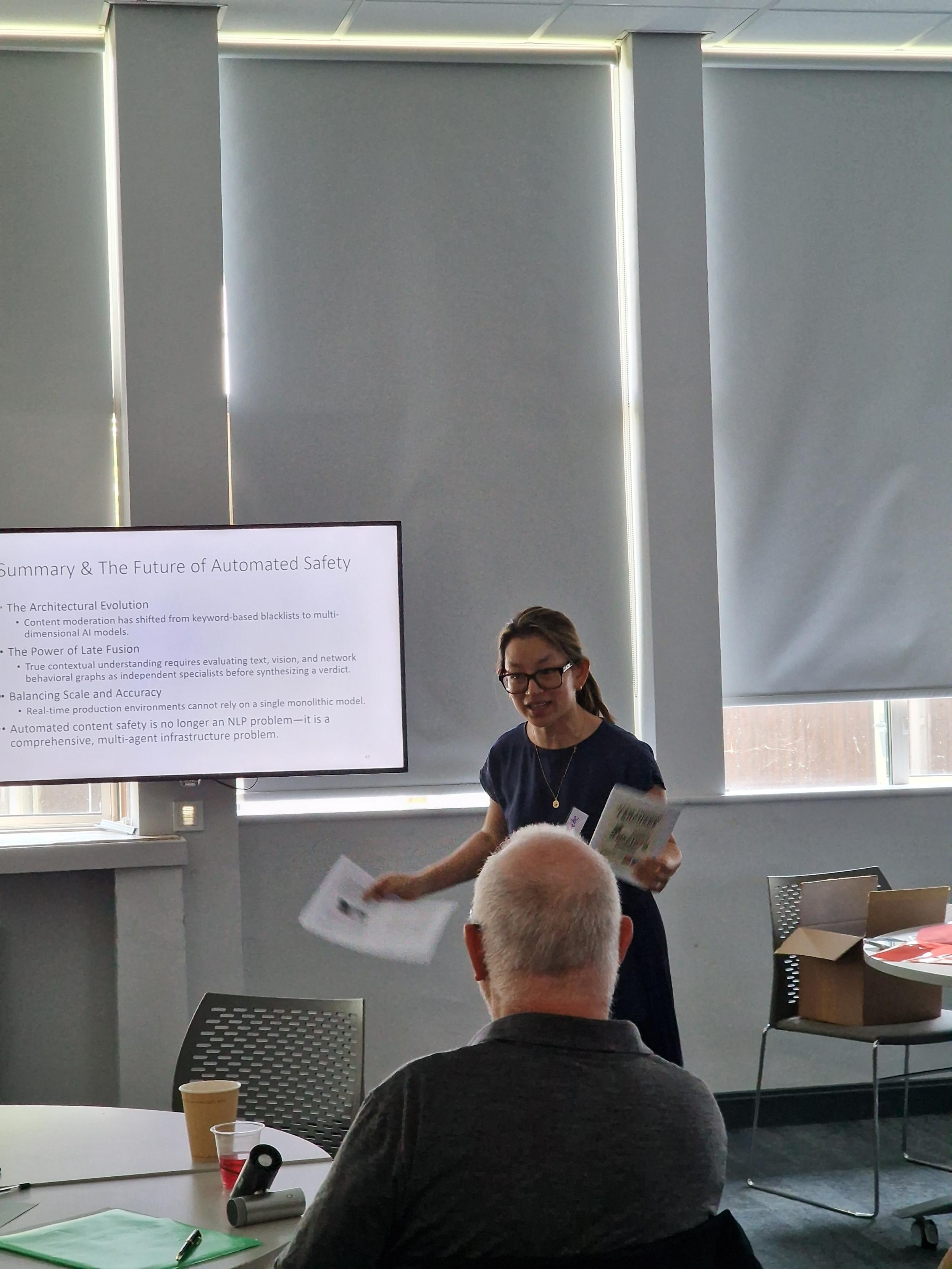
For the next activity, everyone was out of their seats taking part in a hunt to find words that had been hidden around the room. These words were then categorised into hurtful, or healing words and the reasons why were considered.
Participants actually created a third category which gave Phoebe an insightful perspective to take forward in the research. Attendees were then asked to write one phrase that they have encountered that was ‘hurtful’ and one that was ‘supportive/ peaceful’, this activity sparked some meaningful connections and discussions.
Groups were given 10 statements that they had to reframe to be peaceful rather than confrontational and the varying approaches taken by different groups was really interesting. Phoebe then shared the Peace Through Language workbook that she has created, and the education card activity was then undertaken by attendees which involved the reframing of everyday words to be kind and supportive.
The Digital Peace Pledge was then shared, and people were encouraged to submit their own pledges towards making online spacers peaceful through the language they use.
The workshop certainly fostered connection, prompted debate, and generated ideas of how people can be involved in the research moving forward. Thank you to Phoebe and her research collaborators hosting the workshop, and to those who contributed so meaningfully on one of the hottest days of the year so far.
Also, a big thank you to the funders: The workshop was fully funded by the Learned Society of Wales (in partnership with Academi Heddwch Cymru) and partly funded by the Department for Science, Innovation and Technology (DSIT) and the British Academy/Leverhulme.